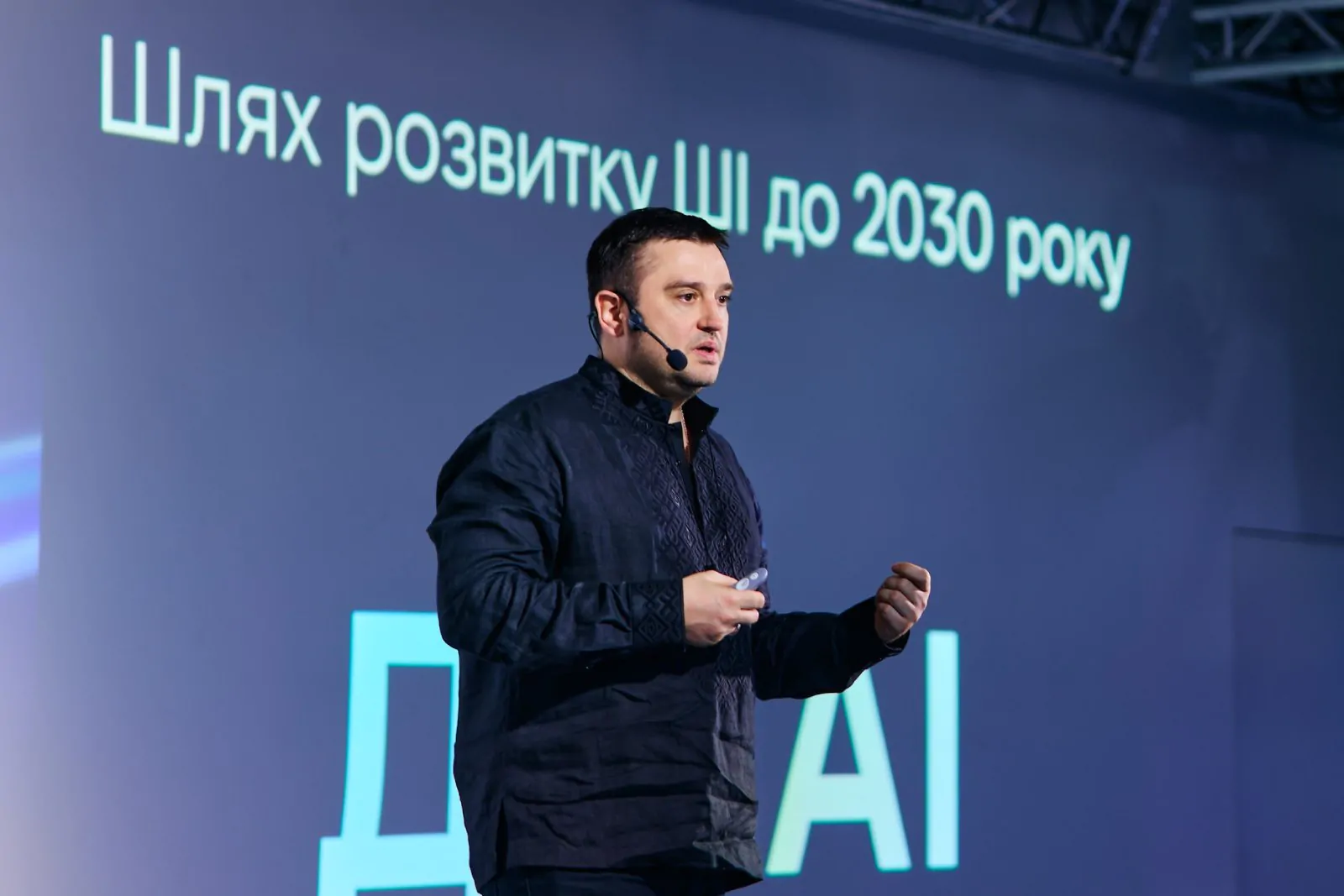
At FutureTech MeetUp: AI-First, Acting Minister of Digital Transformation of Ukraine Oleksandr Borniakov presented a vision for the next stage of the country’s digital transformation, outlining how artificial intelligence will become a core technology of the Ukrainian state.
We will continue building the most convenient state for you, for business and for everyone — especially technology companies — by leveraging modern technologies.
According to Borniakov, the rapid development of generative AI has fundamentally changed how the Ministry of Digital Transformation approaches the design and delivery of public services.
From a Catalogue State to an Agentic State
Over the past several years, the Ministry has focused on bringing government services onto smartphones. The next step is to make these services proactive.
Borniakov describes this evolution as a transition from a ‘catalogue state’ to an agentic state — one that uses technology to become faster, less visible and more human-centred.

In practice, government services will gradually evolve into digital assistants. Instead of searching for the right service independently, people will receive support precisely when and where they need it.
For example, a digital assistant could guide a user through starting a business, changing their registered place of residence or paying a fine. It could also direct them to the appropriate service even when their request was not anticipated by the original algorithm.
This next stage of the digital state will make public services increasingly relevant to each user’s circumstances, actions and needs.
AI Is Already Transforming Government Operations
Artificial intelligence is already embedded in a number of government processes.
Borniakov highlighted an AI-powered recruitment system within the Ministry of Digital Transformation that automates the full hiring cycle, as well as the use of AI to review public procurement documents, significantly reducing processing time.
He also pointed to the launch of Diia.AI, the state’s virtual assistant, which already helps users access public services through natural-language conversations.
Borniakov believes that AI should ultimately become the primary interface between citizens and the state.
Building Ukraine’s AI Infrastructure
The Acting Minister also outlined the broader development of Ukraine’s AI ecosystem.
Key initiatives include the creation of a domestic large language model, the launch of the country’s first AI supercomputer and the development of a regulatory framework for artificial intelligence.
These projects form part of a wider strategy aimed at strengthening Ukraine’s technological self-sufficiency across public services, telecommunications and the development of home-grown technology products.
The Ministry of Digital Transformation is also calling on businesses to contribute to the creation of Ukrainian datasets, which will provide the foundation for future AI solutions.
Diia.City as an Environment for Innovation
Innovation requires more than technology and data. It also depends on a stable environment in which companies can develop, invest and scale. Today, Diia.City provides such an environment.
Its dedicated legal and tax framework enables companies to plan their long-term development, attract investment, scale internationally and concentrate resources on building technology products.
The combination of a favourable regulatory environment and a mature product ecosystem creates the conditions for Ukrainian AI solutions to compete globally.

From Individual Processes to System-Level Change
Borniakov also shared examples of how artificial intelligence could transform entire sectors.
In the judiciary, AI can help analyse standard administrative cases and prepare draft decisions for judges, reducing the time spent on routine tasks.
In education, the Mriia app already uses algorithms to generate timetables and support teachers with assessment. In the future, it is expected to help create personalised learning pathways for every child.
According to Borniakov, these ecosystem-level solutions demonstrate the real potential of artificial intelligence: not simply to automate individual processes, but to fundamentally change how entire systems operate.
Ukraine has a unique advantage — a society prepared to adapt rapidly to digital change. This enables the country to remain a global example of digital transformation and move confidently towards a new generation of proactive, AI-powered public services.