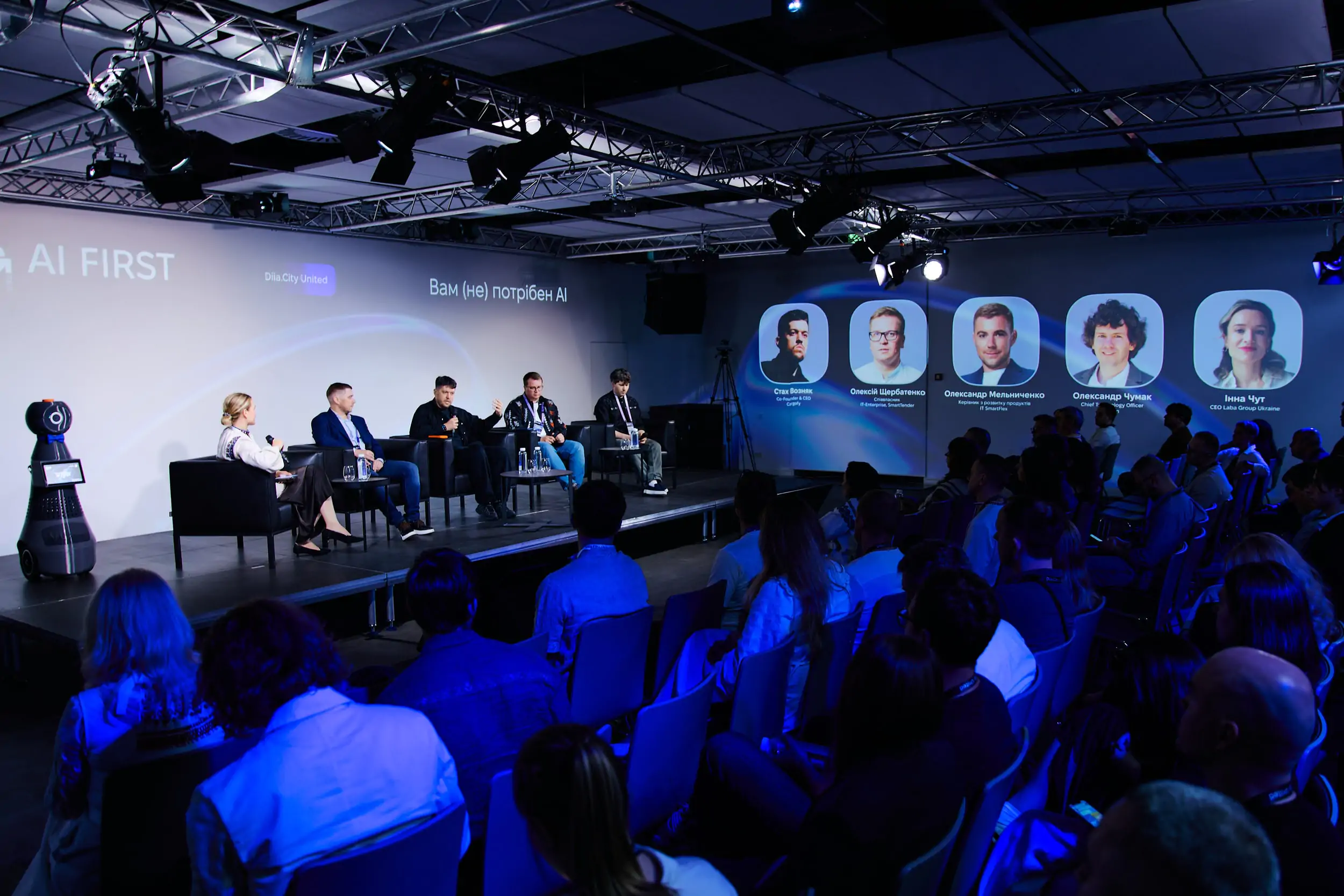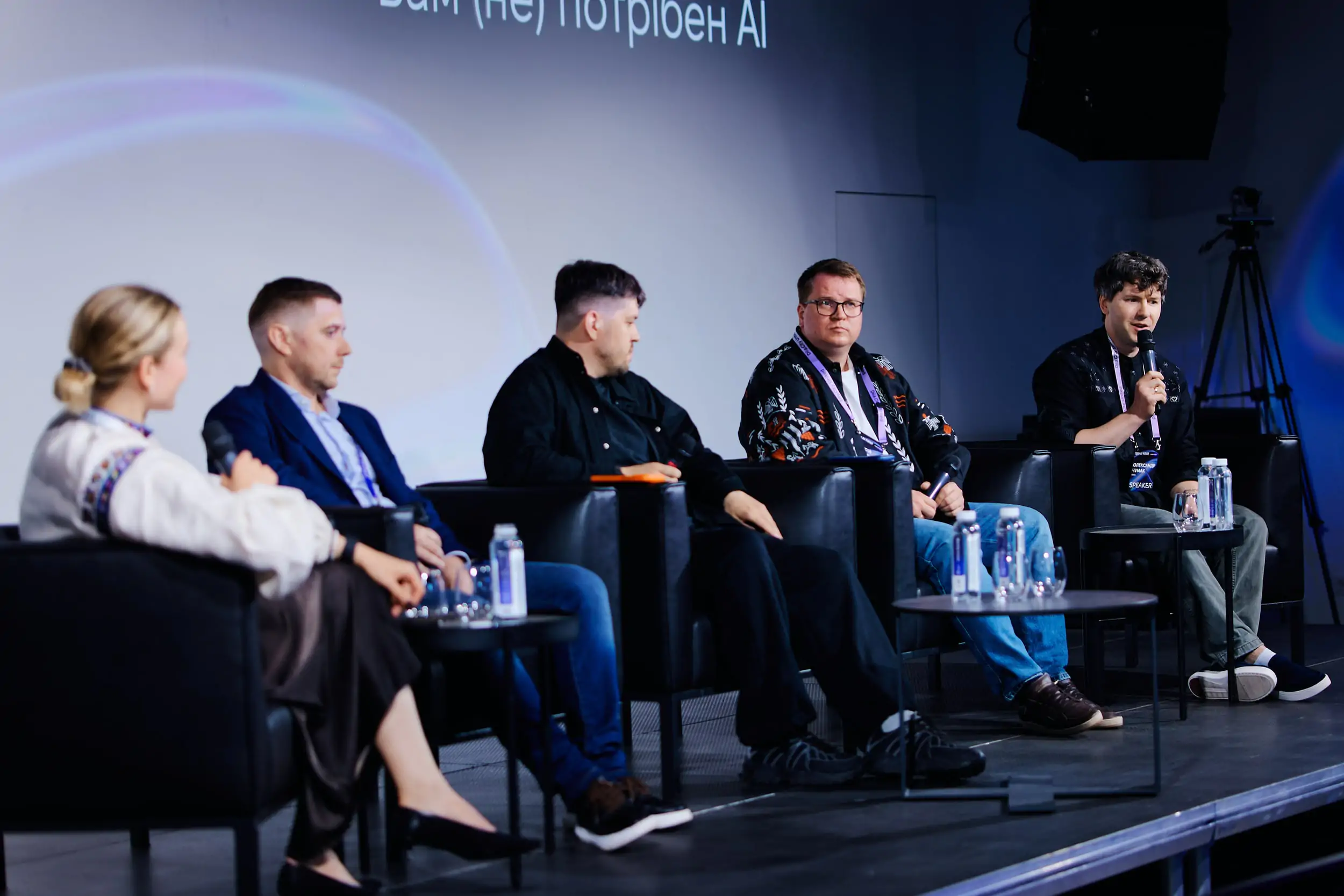
Where does AI genuinely drive profit, and where are businesses simply chasing the hype? That question ran through the closing panel of FutureTech MeetUp: AI First. Senior executives from Uklon, Cargofy, IT-Enterprise and IT SmartFlex, who work with AI in their products every day, gave an honest overview of what has worked in real practice and what has gone badly wrong.

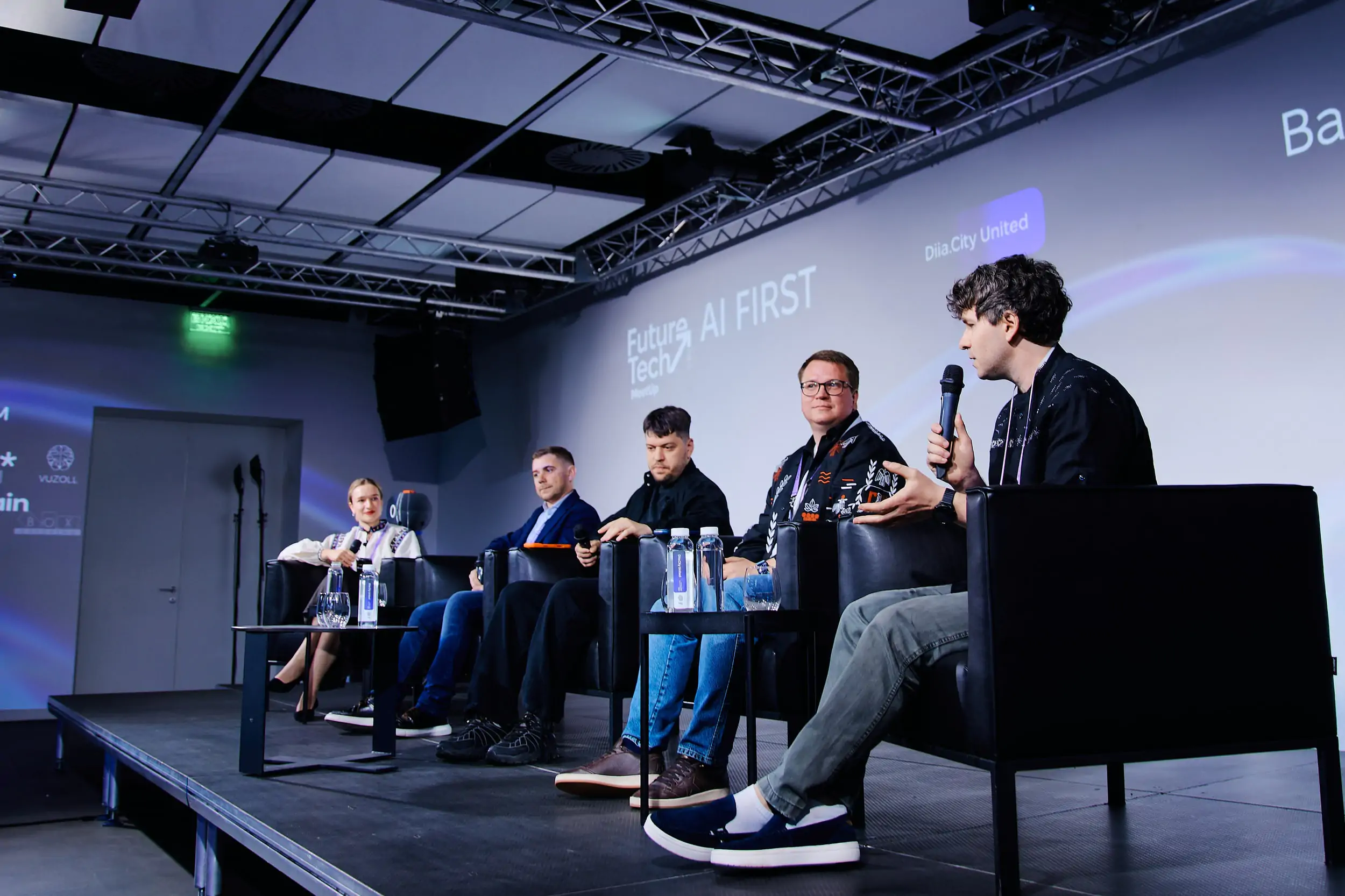
Inna Chut, CEO of Laba Group Ukraine, moderated the panel. Sharing their experience were Oleksandr Chumak, CTO of Uklon; Oleksandr Melnychenko, Head of Product Development at IT SmartFlex; Oleksii Shcherbatenko, Co-owner of IT-Enterprise and SmartTender; and Stakh Vozniak, CEO and Co-founder of Cargofy.
The conversation was structured around three key pillars: where AI has paid off, where it has failed, and where it should never have been introduced in the first place.


Where AI pays off
Cargofy deployed a voice AI agent inside a US logistics firm, where around 70% of carriers are owner-operators. These drivers can’t use an app while at the wheel, so voice proved a natural fit, Vozniak said. The company’s ‘AI worker’ now handles up to 500 calls a minute. Cargofy is careful not to present this as something replacing people; it frames the tool as a ‘super-power’ for staff.
Uklon has built almost its entire marketplace on AI. Processing hundreds of thousands of orders a day and matching thousands of drivers with passengers every second takes an ecosystem of several thousand AI models. They handle everything from address selection and route optimisation to dynamic pricing and predicting a driver’s next fare.
Chumak said the company improved its conversion funnel by 1–2% a year. With quarterly revenue of $33 million, that works out roughly $1 million in extra income each year.
IT SmartFlex built a call-analysis tool for Vodafone’s contact centre that scores conversation quality and gives agents practical advice. The result was a 21% rise in sales conversions and an 11% drop in call duration.
For Oleksii Shcherbatenko, scale is the real test of any AI solution. The SmartTender platform lists 10,000 new tenders a day, and IT-Enterprise‘s ERP system processes 28,000 documents at the start of each year. A manager used to spend a full working day reading 120 pages of procurement documents only to pull out delivery points and check the prices. The same task now takes from one to two minutes, saving clients around 8,000 hours a year.

Blunders, suspended accounts and the economics of scaling
Industry conferences tend to hype on overnight-success stories. In practice, implementation usually means months of iterative fixes and a fair few mistakes along the way.
- Economies of scale. IT-Enterprise’s first big misstep was cost. When the team launched its tender-recognition feature, a single query cost about €10, far too much to sell at a sensible price. They spent several months rebuilding the model to cut costs down. The lesson: the unit economics of your thousandth request look nothing like those of your tenth.
- The machine uprising. Vozniak described a digital employee that was asked to schedule a weekly recurring call. A simple logic flaw led the agent to create a separate meeting every week, sending invites, collecting rejections and resending them. It booked hours of meetings in advance, filled the email client’s memory and got the corporate account suspended by Google. The lesson: AI agents need firm boundaries and very specific prompts.
- Organisational pushback. For Oleksandr Chumak, the hardest part was organisational. Running a workshop and announcing that ‘everyone uses AI now’ achieved little. A top-down rollout across Uklon’s HR and admin functions just failed; the company had to redesign its underlying processes and structure. The lesson: that change should have started a year earlier.


When to steer clear of AI
To wrap up the panel, moderator Inna Chut challenged the speakers to cut up three business cases driven largely by blind industry hype.
Case 1: The creative agency. The owner is ready to spend $100,000 on AI because ‘everyone else is’.
Oleksandr Melnychenko pointed to the classic mistake: starting with the budget rather than the business problem. Companies should first map the repetitive tasks they can automate, and only then set a budget, which might take from $5,000 to $200,000. Spending for the sake of hype is the worst approach.
Case 2: The Excel-reliant manufacturer. A traditional company is desperate to adopt AI to keep up with rivals.
Oleksii Shcherbatenko offered a reality check: the problem isn’t writing the code, but the lack of in-house technical expertise. Without an internal IT team, you are far better off buying a solid off-the-shelf solution than building custom scripts that no one will be around to maintain.
Case 3: The illusion of demand. Inna Chut shared a cautionary tale from Laba Group.
After gathering a waiting list of about 100 people ‘interested’ in a new AI course, the team rushed to launch it. In the end, four people actually signed up in total. Stated interest and a genuine willingness to part with cash are two entirely different things.
Thank you
The FutureTech MeetUp: AI First took place with the support of Diia.City United’s trusted partners: AI HOUSE, IT SmartFlex and HPE by Sophela.
Our thanks also go to all the friends of the Association who helped make the evening a special one: Diia.City, Ukrainian Startup Fund, American Chamber of Commerce in Ukraine, Ukrainian Corporate Governance Academy, Vuzoll, Challenger Accelerator, Radar Tech, De Novo, DOU, Defender Media, Marketer, dev.ua, AIN.UA, Tala Water, Underwood Brewery, Kyiv Kraut, Kombucha Wild, BOX Catering and Sheriff Holding.
More from FutureTech MeetUp: AI First
Read the highlights of the ‘AI in Defence Tech’ panel, covering the autonomy of combat technologies, the ethical limits of AI and progresive vision for developing Ukraine’s defence tech sector.
Dmytro Voitekh, AI/ML Lead at Mriia and adviser on AI to the Deputy Minister of Economy, used his keynote to point at what models still can’t see: the millions of Ukrainian handwritten documents in archives and government offices. RUKOPYS, the country’s first open annotated dataset of handwritten text, was built to open up to AI and optical character recognition. Learn more.