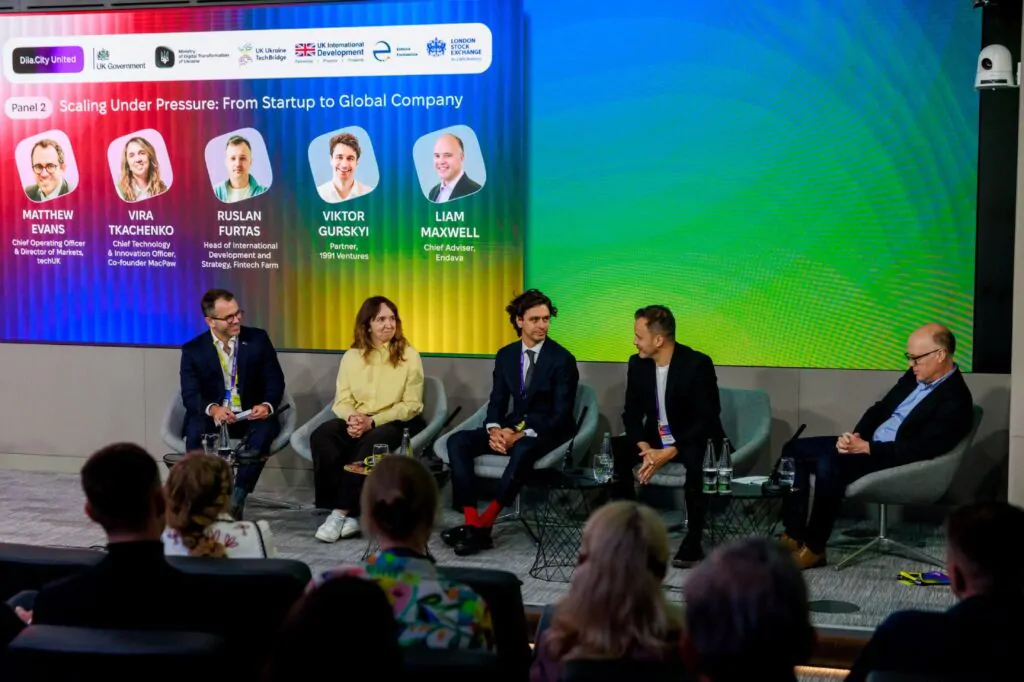
At Diia.City United, we hosted an exclusive Q&A with Hanna Shuvalova, Principal at Horizon Capital and member of our Association’s Strategic Board.
The discussion focused on attracting investment and scaling Ukrainian tech products to global markets.
The meeting took place in the welcoming Genesis Space, and when an air raid alert sounded, participants moved to the shelter where they had the unique opportunity to continue their personal conversations with Hanna and receive her direct advice.


Education and Career Beginnings
Hanna opened the session by sharing her journey from Greek philology to becoming a principal at Ukraine’s largest investment fund.
My switch to technology happened during the Maidan and the beginning of the war, because the main solar energy assets were located in Crimea, and this dramatically changed the entire investment landscape in Ukraine, Hanna reflected on the end of her career at Activ Solar.
From Genesis to Horizon Capital
Hanna’s interest in the tech sector began in 2014, when there were only a handful of product companies in Ukraine and few people understood what it was all about.
In 2015, she joined Genesis, where she helped the team develop fundraising strategies. The entire company staff numbered no more than 150 people at the time.
However, Hanna had always dreamed of working at Horizon, but getting there wasn’t straightforward:
I even applied for a position, but wasn’t accepted the first time. I had to take a roundabout path, she admits.
According to Hanna, her work at Genesis provided valuable expertise in operational work within a product company.
Thanks to this experience, in 2017 Hanna finally landed her dream position at Horizon Capital, where she was exclusively responsible for the technology sector.
At that time, Horizon had several investments, including Ciklum, Rozetka, and Jooble, and it was becoming obvious to the fund that the investment attractiveness of the technology sector was growing, so they began developing this expertise, Hanna recalls.
Stanford Business School and Pawa
Later, Hanna decided to pursue her education at Stanford Business School, where she earned a Master’s degree in Management.
Stanford University is located in Silicon Valley, where everything encourages you to try founding something, co-investing, doing something risky. All the conditions are created for this there, with tremendous access to resources… Hanna remembers.
Part of her founder experience included the venture studio Pawa, which Hanna created with partners and friends within the Roosh ecosystem to support AI startup creation in Ukraine.
We helped the companies we incubated move to the next stage and decided not to continue, the investor shared.
With the start of the war, the project was suspended, and in May 2023, Hanna returned to Horizon Capital as Principal, where she actively worked on developing the technology portfolio and supporting startups.


During the session, the speaker answered numerous questions from participants about attracting investment.
The Path to Investor
According to Hanna, often getting investment from a fund simply requires a match between your startup’s development stage and the investor’s activity specifics.
If your company is going to raise investment, you need to do your homework. I often see many irrelevant applications – in emails, LinkedIn, Telegram channels, and WhatsApp.
People think that if they write everywhere, they’ll definitely get a response somewhere.
Actually, that’s not how it works. It’s enough to do very simple work – read the investment thesis of the fund you want to contact, Hanna advises.


How to Get in the Pipeline?
We asked Hanna whether a company must meet high profitability criteria to begin communication with such a large fund as Horizon Capital, and how to get into their pipeline.
Hanna explained:
We very often participate in almost all technology events – you can meet us there, you can write on LinkedIn. If a startup is very small, we often do startup events together with accelerators, and we also mentor startups.
According to Hanna, communication with more mature businesses often begins 1-2 years before investment:
We enter with fairly large checks. At the same time, we’re very founder-friendly, and we want companies we invest in to be comfortable with us. Therefore, the dating period is very important for us, Hanna explained.
In some cases, it can take even 10 years from acquaintance to actual investment. It’s important to see the company’s development trajectory.
When founders set goals for themselves and then achieve them – these are very useful signals for making investment decisions, the investor noted.
Horizon Capital Investment Criteria
For decision-making, the fund pays attention to:
- Market potential: sector analysis and growth prospect
- Team: ambitions, strategic thinking, and ability to build a strong team
- Financial metrics: evaluation of past results and forecasts
- Due diligence before closing deals, including KYC on founders
- Strategic fit: how well the company aligns with the fund’s strategy
- Scalability: business ability to expand and enter international markets
Technology Trends
Hanna highlighted several key directions:
- AI and Machine Learning: All companies will be AI companies to some extent within five years.
- Robotics: AI is driving robotics development, and we’re seeing more and more interesting examples.
- Quantum Computing: Google released a new paper on this topic, and Ukraine also has companies working in this direction, such as Haiku.


Potential of Ukrainian Tech Startups
Ukrainian startups have great potential in the global market due to high-quality development and competitiveness.
Hanna Shuvalova cited companies like Adeos Robotics and Asper Bionics as examples of successful projects.
Women’s Leadership
Hanna Shuvalova is one of only two women in Horizon Capital’s top management, which is a significant achievement in the investment sphere, traditionally dominated by men.
She noted that her path to this position wasn’t easy, but colleague support and her own persistence helped her achieve success.
For me, women’s leadership is, first and foremost, personal example. I always support all the women who strive to develop in business.
Government Collaboration
Hanna emphasized the need for transparent communication between business and government to create favorable business conditions.
Now we see more and more that even international players are reducing their presence in Ukraine, Hanna noted. It’s important to unite the efforts of technology companies within associations, for associations to unite and promote these things.
This is exactly what Diia.City United business association is about: our priority #1 is to establish fair rules of engagement between government and the technology sector.


Nataliya Mykolska, Executive Director of Diia.City United, reminded about the Association’s mission:
We unite to accelerate the integration of the technology industry into the EU market and globally.
——-
Ready to join the conversation? Diia.City United regularly hosts exclusive sessions with industry leaders, investors, and policymakers. Become our member for the access to our valuable networking and development opportunities.