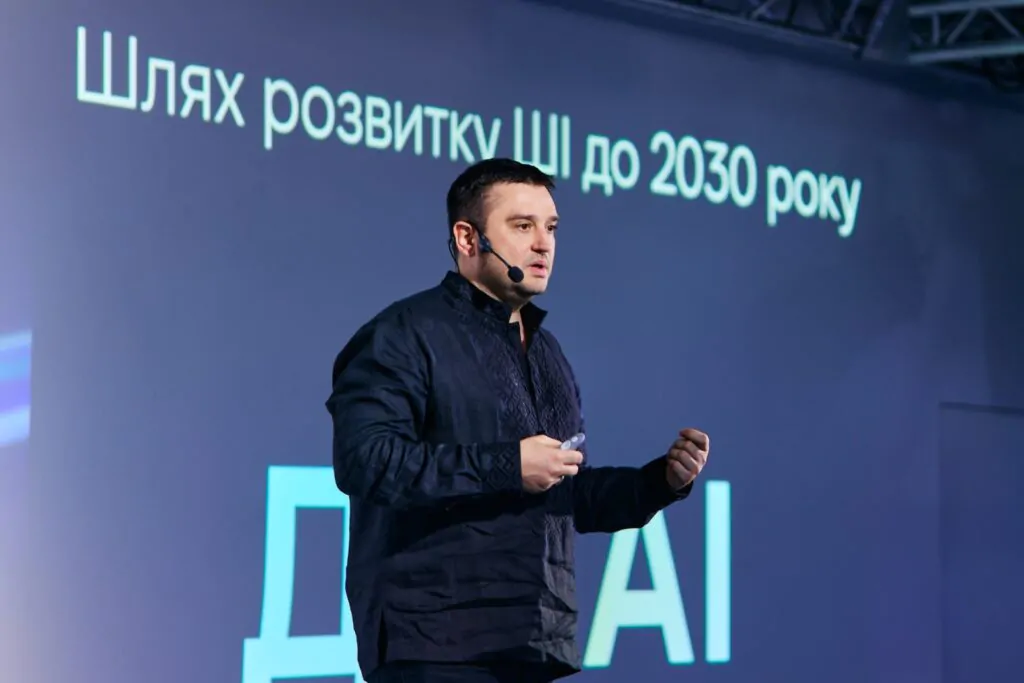
On February 6, just ahead of the Diia.City legal framework’s fourth anniversary, leaders of Diia.City United member tech companies had a closed meeting with Oleksandr Bornyakov in his new role as Acting Minister of Digital Transformation. Deputy Minister Natalia Denikeieva also joined the discussion.
The primary takeaway was clear: despite recent leadership updates, the Ministry’s strategic course remains steadfast. The focus continues to be squarely on advancing innovation, building a robust digital state, and driving the digital economy forward.
Here is a brief look at the most interesting points from the conversation.
From a Digital State to an Agentic State
2026 is set to be the year of sweeping AI integration into public services. The Ministry aims to radically shift how citizens interact with the state: moving from a search-based model to a proactive one.
The system will identify a citizen’s life circumstances, with AI agents automatically preparing documents and guiding users through processes. This model saves time while minimising human error and corruption risks.
The cornerstone of this initiative will be a sovereign Ukrainian Large Language Model (LLM), developed on the Google Gemma architecture. A technical partnership with Kyivstar ensures this model is being built without utilising state budget funds.
Currently, the team is processing terabytes of unique data — ranging from state archives to scientific papers — to train the model on the deep nuances of the Ukrainian context, language, and history. A beta version of the national LLM is slated for release in April 2026, and citizens will choose its name via a poll in the Diia app.


Diia.City R&D
The Diia.City space is evolving. According to Natalia Denikeieva, the Ministry’s team is currently focusing on the Diia.City R&D project. This initiative introduces a tailored set of incentives for engineering and manufacturing companies, whose operational needs differ significantly from traditional IT. The core objective is to spur innovation in DefenseTech, AgriTech, and energy, ultimately expanding Ukraine’s export potential.
Diia.City Invest
The absence of effective venture investment tools remains one of the major roadblocks for startup growth in Ukraine. Forced by this lack of domestic infrastructure, Ukrainian entrepreneurs often have to register their companies abroad to access capital.
To tackle this, the Ministry has launched the Diia.City Invest initiative, conceptualised in partnership with the National Securities and Stock Market Commission (NSSMC). The proposed mechanism will allow the venture funds to be created without a requirement for an Asset Management Company (AMC) license, streamlining fund registration to a matter of weeks.
Key features of Diia.City Invest:
- Ukrainian businesses will be able to legally reinvest their profits into tech companies while remaining entirely within the Ukrainian legal framework.
- Funds can invest directly in the corporate rights and securities of Diia.City residents.
- Resident startups will no longer lose their status if they temporarily exceed income thresholds during funding rounds.
- The legalisation of English law elements makes the Ukrainian jurisdiction much more transparent, predictable, and familiar to international investors.
As Natalia Denikeieva emphasised, this tool will serve as a bridge for domestic capital, make Ukrainian startups more comprehensible to global investors, and boost the overall capitalisation of the tech sector.
Deregulation and Virtual Assets
The primary task right now is to pass legislation that complies with European MiCA regulations while simultaneously creating competitive advantages for businesses operating in Ukraine. The main hurdle remains the position of public sector representatives, specifically the National Bank and the NSSMC.
However, the Ministry is optimistic about maintaining a constructive dialogue with the head of the NSSMC, leveraging his experience in Western markets. The goal for the first half of 2026 is to reach a practical compromise: ensuring regulation is proportionate to the risks, allowing Ukraine to attract global Web3 startups rather than losing them to other jurisdictions.
For the member companies of Diia.City United, direct engagements like these «Dialogues with the Government» remain an indispensable practical tool for staying synced with the state. We clearly see the Ministry of Digital Transformation’s clear willingness to listen to business needs and implement necessary changes, and we appreciate the team for four years of solid, ongoing partnership.